How to Simplify Fractions Instantly — Step-by-Step Shortcut Method

SpeedMath Team · 05 Apr 2026

How to Simplify Fractions Instantly — Step-by-Step Shortcut Method

Fractions appear in nearly every branch of mathematics — arithmetic, algebra, geometry, data interpretation, and probability. Yet for many students, simplifying fractions remains slow and uncertain. The standard approach of finding the HCF through repeated prime factorization works correctly but inefficiently, especially under exam time pressure.

Division Shortcuts: How to Divide Large Numbers in Under 5 Seconds

SpeedMath Team · 04 Apr 2026

Division Shortcuts: How to Divide Large Numbers in Under 5 Seconds

Division is the arithmetic operation most people find slowest and most error-prone. Multiplication has dozens of well-known shortcuts — but division shortcuts are rarely taught systematically, leaving most students dependent on long division even when faster methods exist.

Vedic Math Tricks for Competitive Exams — The Complete 2026 Guide

SpeedMath Team · 03 Apr 2026

Vedic Math Tricks for Competitive Exams — The Complete 2026 Guide

Vedic Mathematics is a system of mental calculation derived from ancient Indian scriptures called the Vedas. Rediscovered and compiled by Bharati Krishna Tirthaji in the early 20th century, it consists of 16 main sutras (formulas) and 13 sub-sutras that cover virtually every branch of arithmetic and algebra.

RRB NTPC Math Preparation: Solve 20 Questions in 5 Minutes

SpeedMath Team · 02 Apr 2026

RRB NTPC Math Preparation: Solve 20 Questions in 5 Minutes

The RRB NTPC Computer Based Test contains 30 mathematics questions to be solved within a combined 90-minute window shared across three sections. In practice, strong candidates allocate roughly 25–30 minutes to the mathematics section — meaning each question must be answered in under 90 seconds on average.

IBPS PO Quantitative Aptitude: Fast Calculation Techniques That Actually Work

SpeedMath Team · 01 Apr 2026

IBPS PO Quantitative Aptitude: Fast Calculation Techniques That Actually Work

The IBPS PO Preliminary examination contains 35 quantitative aptitude questions to be solved in 20 minutes — a pace of just 34 seconds per question. The Mains examination is more generous with time but significantly more complex, featuring data interpretation sets, data sufficiency, and higher-order arithmetic that demand both speed and analytical depth.

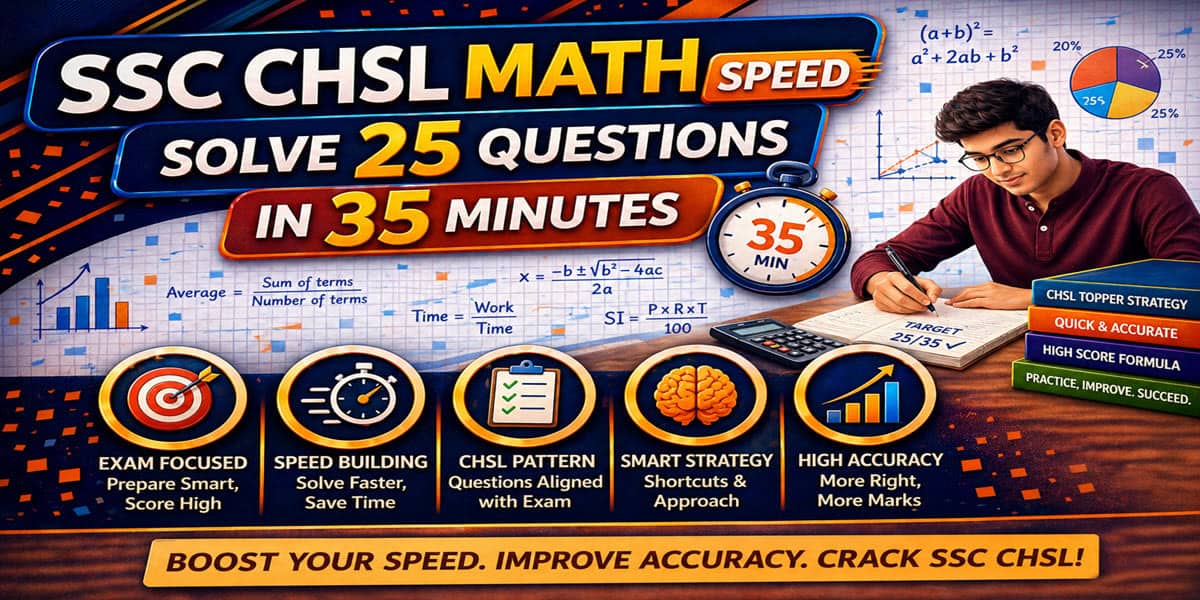
SSC CGL Math Speed Strategy: Solve 25 Questions in 40 Minutes

SpeedMath Team · 01 Apr 2026

SSC CGL Math Speed Strategy: Solve 25 Questions in 40 Minutes

The SSC CGL Tier 1 examination gives you 60 minutes to answer 100 questions across four sections. The Quantitative Aptitude section contains 25 questions — meaning you have roughly 40 minutes if you allocate time equally, but in practice most candidates finish General Awareness quickly and redirect that time to Math and Reasoning.

Percentage Calculation Made Easy: Solve Any Percentage in Under 10 Seconds

SpeedMath Team · 30 Mar 2026

Percentage Calculation Made Easy: Solve Any Percentage in Under 10 Seconds

Percentages are everywhere — in exam papers, bank interest calculations, discount offers, tax computations, salary hikes, and data interpretation tables. Yet for many students, percentage calculations remain slow, error-prone, and mentally exhausting.

How to Calculate Squares of Numbers 1 to 100 in Seconds

SpeedMath Team · 29 Mar 2026

How to Calculate Squares of Numbers 1 to 100 in Seconds

In almost every competitive exam — SSC, IBPS, CAT, RRB, UPSC — squares of numbers appear repeatedly. They show up in simplification problems, geometry questions, algebra, data interpretation, and number series. A candidate who instantly knows that 67² = 4489 or 83² = 6889 has a measurable edge over someone who must work it out from scratch.

How to Memorize Multiplication Tables 1 to 30 Using Patterns (Fast & Easy)

SpeedMath Team · 28 Mar 2026

How to Memorize Multiplication Tables 1 to 30 Using Patterns (Fast & Easy)

Most students memorize multiplication tables up to 10 through sheer repetition. Then they hit table 11, 12, or beyond — and suddenly the rote memorization approach stops working. The numbers feel arbitrary, the patterns disappear, and the frustration begins.

Advertisement

Ready to put it into practice?

Apply what you've learned — sharpen your speed, test your knowledge, and challenge yourself.